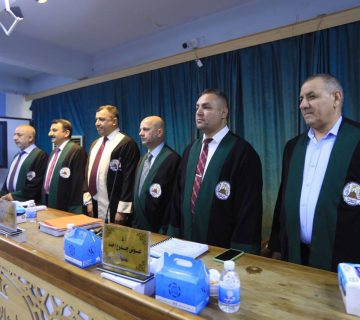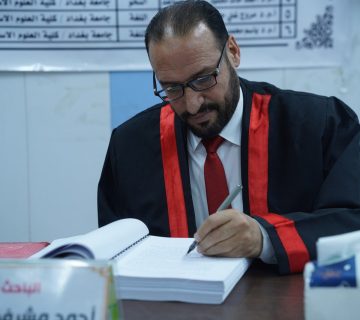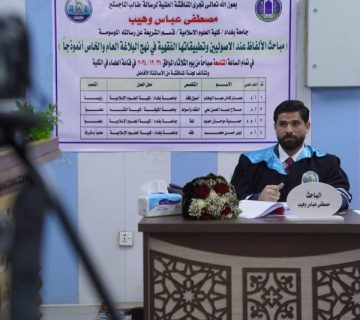


The College of Islamic Sciences at the University of Baghdad witnessed the academic defense of a PhD dissertation titled “The Prophetic Sunnah’s Approach to Tribal and Social Customs: A Contemporary Thematic Study,” submitted by doctoral candidate Latifa Kareem Salih from the Department of Islamic Creed and Thought (Specialization: Hadith). The defense was attended by the Dean of the College, Prof. Dr. Ni’mah Dahash Farhan, alongside a gathering of professors, researchers, specialists, and students.
The significance of this study lies in inductively examining the Prophetic methodology in engaging with social reality, grounding its impact on rectifying prevailing customs and traditions, and collecting and analyzing relevant Prophetic texts and hadiths. The dissertation addresses a critical research and academic gap as a specialized study dedicated to uncovering the regulatory frameworks of the Prophetic Sunnah in dealing with tribal and social phenomena—ranging from affirmation (Iqrar) and refinement (Tahdhib) to invalidation (Ibtal)—and highlighting the synthesis between the constants of Shariah rulings and the variables of customary reality.
In a related context, the objectives of the dissertation and the rationale for selecting the topic centered on serving the Noble Prophetic Sunnah by presenting Prophetic guidance in a manner aligned with contemporary discourse, acquainting the present generation with the flexibility of Shariah and its capacity to accommodate social changes, and clarifying the Sunnah’s stance on prevailing customs in contemporary reality, particularly within the Arab and Iraqi contexts, utilizing an inductive, analytical, and thematic methodology.
The researcher established several key findings, most notably that the Prophetic Sunnah’s engagement with tribal and social customs was neither based on absolute rejection nor absolute acceptance; rather, it was characterized by balance, realism, and integration between the higher objectives of Shariah (Maqasid al-Shariah) and customary variables. The Sunnah focused on preserving the social fabric by affirming customs grounded in justice, mutual compassion, and social solidarity, reforming those in need of rectification, and invalidating pre-Islamic (Jahili) customs rooted in tribalism (‘Asabiyyah), injustice, and blind imitation.
At the conclusion of the defense, the dissertation presented a set of recommendations, emphasizing the need for researchers and academic institutions to dedicate independent, thematic hadith studies to address contemporary customary and social phenomena, and to utilize Prophetic concepts and insights in reforming prevailing traditions. It also recommended strengthening the role of educational and pedagogical institutions in instilling lofty Islamic values and grounding the principles of justice and equality.
Based on the valuable cognitive and scholarly contributions presented in the dissertation, the Examination Committee approved the dissertation in partial fulfillment of the requirements for the Doctor of Philosophy (PhD) degree in Islamic Creed and Thought. The Examination Committee comprised:
-
Prof. Dr. Ahmed Shaker Mahmoud – Chair
-
Prof. Dr. Salah Naji Abdul-Zahra – Member
-
Prof. Dr. Ibrahim Abdul-Salam Yaseen – Member
-
Asst. Prof. Dr. Khalid Faraj Hassan – Member
-
Asst. Prof. Dr. Abdul-Malik Saadi Nayef – Member
-
Prof. Dr. Mohammed Siraj Al-Din Qahtan – Member and Supervisor