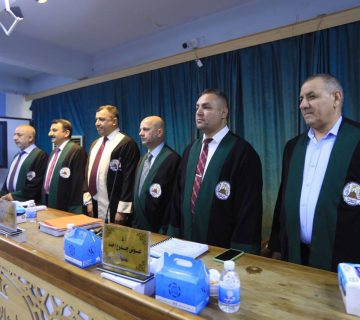


The College of Islamic Sciences at the University of Baghdad witnessed the academic defense of a PhD dissertation titled “The Higher Objectives of Shariah (Maqasid al-Shariah) Agreed Upon by Imams Al-Bukhari and Muslim: The Section on Transactions,” submitted by doctoral candidate Zeina Jabbar Nasser Hassoun from the Department of Shariah (Specialization: Principles of Islamic Jurisprudence / Usul al-Fiqh). The defense was attended by the Dean of the College, Prof. Dr. Ni’mah Dahash Farhan, alongside a gathering of professors, researchers, specialists, and students.
The significance of this study lies in elucidating the higher objectives of Islamic law (Maqasid al-Shariah) within the Prophetic Sunnah and grounding the impact of their application on the jurisprudence of transactions (Fiqh al-Mu’amalat) and financial dealings, specifically through the Muttafaqun ‘Alayh hadiths (narrations agreed upon in Sahih al-Bukhari and Sahih Muslim). The dissertation addresses a critical research and academic gap as a specialized study dedicated to uncovering the correlations between hadith indications and both classical and contemporary financial rulings and issues. Furthermore, it highlights the role of synthesizing and integrating the sciences of Usul al-Fiqh, Islamic legal maxims (Al-Qawa’id al-Fiqhiyyah), and Maqasid al-Shariah in deriving rulings for financial transactions.
In a related context, the objectives of the dissertation and the rationale for selecting the topic centered on deepening scholarly engagement with the science of Maqasid al-Shariah and exploring the intersections between Shariah objectives and the textual indications of Prophetic hadiths regarding financial rulings and issues. Additionally, the study aims to lay a new foundation in the field of Maqasid by examining hadiths related to both classical and modern transactions, and clarifying the legislative purposes and underlying rationales (‘Ilal) in the Prophetic Sunnah—recognizing them as among the most effective means of calling to Islam due to their inherent focus on securing public interest (Jalb al-Maslahah) and preventing harm (Dar’ al-Mafsadah), all conducted through an inductive-deductive methodology.
The researcher established several key findings, most notably that the Prophetic Sunnah serves to clarify and elaborate upon the rulings of the Holy Qur’an while encompassing the underlying rationales and objectives of legislation. The study also demonstrated that the rulings of Islamic financial transactions are anchored in the preservation and growth of wealth, as well as the safeguarding of its essential (Daruriyyat), complementary (Hajiyyat), and embellishing (Tahsiniyyat) objectives, operating as an integrated system designed to alleviate hardship, secure benefits, and avert harm from legally accountable individuals (Mukallafin). Moreover, the findings underscored the necessity of harmonizing textual proofs with Maqasid al-Shariah during legal deduction (Istinbat) and independent legal reasoning (Ijtihad) to ensure that legal rulings align with the intent of the Lawgiver.
At the conclusion of the defense, the dissertation presented a set of recommendations, emphasizing the need for researchers and academic institutions to expand their study of Maqasid al-Shariah and utilize them in addressing modern financial issues and emerging cases (Nawazil). It further recommended dedicating independent, specialized studies to contemporary transactions to clarify the higher objectives behind their rulings, alongside strengthening the role of educational and academic institutions in linking Usul al-Fiqh, Fiqh al-Mu’amalat, and Maqasid al-Shariah to facilitate legal rulings and ground the principles of Islamic jurisprudence.
Based on the valuable cognitive and scholarly contributions presented in the dissertation, the Examination Committee approved the dissertation in partial fulfillment of the requirements for the Doctor of Philosophy (PhD) degree in Islamic Sciences (Specialization: Usul al-Fiqh). The Examination Committee comprised:
Prof. Dr. Raghad Hassan Ali – Chair
Prof. Dr. Sukaynah Hussein Kadhim – Member
Asst. Prof. Dr. Ahmed Alawi Hussein – Member
Asst. Prof. Dr. Mustafa Kadhim Mahmoud – Member
Asst. Prof. Dr. Dhia Al-Din Hamza Ismail – Member
Asst. Prof. Dr. Mohammed Jassim Mohammed – Member and Supervisor