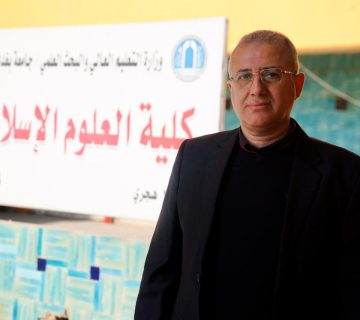

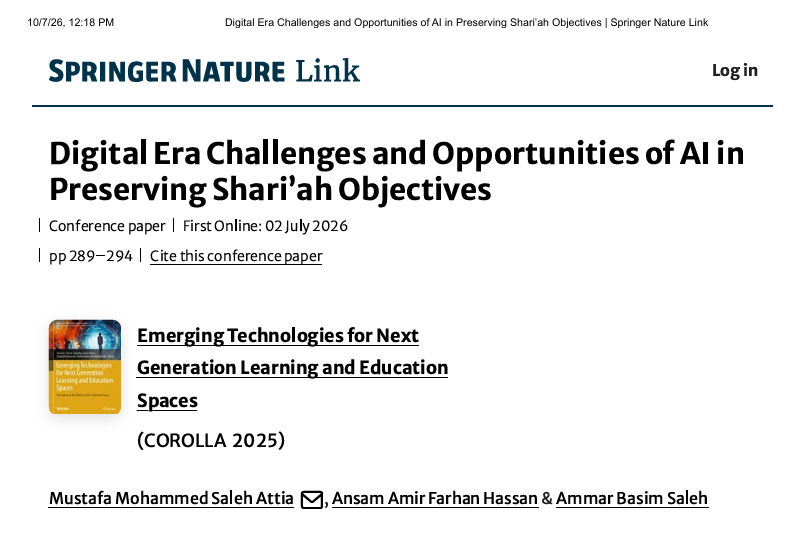
Faculty members at the College of Islamic Sciences, University of Baghdad, have achieved a distinguished scientific milestone by publishing a joint research paper with the global publisher Springer Nature, as part of the book series (Advances in Science, Technology & Innovation) (ASTI), in the volume titled (Emerging Technologies for Next Generation Learning and Education Spaces).
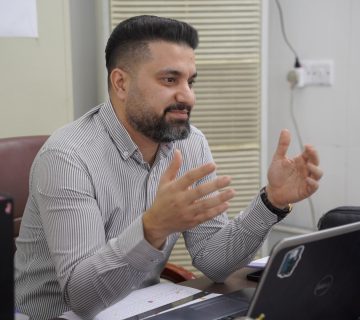
The research, titled “Digital Era Challenges and Opportunities of AI in Preserving Shari’ah Objectives,” was co-authored by Dr. Mustafa Mohammed Saleh Attia, Dr. Ansam Amir Farhan, and Dr. Ammar Basim Saleh from the College of Islamic Sciences at the University of Baghdad.
The study explores the challenges and opportunities associated with deploying artificial intelligence in the digital era, examining the potential of these technologies across education, economics, law, and social services in alignment with Islamic values and ethics while preserving the objectives of Shari’ah (Maqasid al-Shariah).
Additionally, the paper highlights the importance of balancing technological advancement with ethical principles by addressing critical issues such as privacy, bias, and socio-economic impacts, thereby promoting the responsible use of AI to serve humanity and society.
The topic aligns with several United Nations Sustainable Development Goals (SDGs), notably SDG 4: Quality Education and SDG 16: Peace, Justice, and Strong Institutions. It underscores the significance of responsibly leveraging technological innovation, enhancing education, and supporting the development of institutions built on ethics, values, and sound governance.
This achievement reaffirms the commitment of the College of Islamic Sciences at the University of Baghdad to advancing interdisciplinary research and expanding its academic presence in international scientific publications, particularly in fields that bridge Islamic studies and modern technology.